
Every month, a different aurora
Northern lights
People ask me which month is best for seeing the northern lights, and for a long time I wanted to give them a clear-cut answer: one specific month. Now that I’ve watched the northern lights winter after winter from the same spot in Finnish Lapland, I have a more honest answer: there isn’t just one best month, because every time you look up, you see a different display of the northern lights.
I’ve seen it change, from the quiet months with a single broad band floating over the trees to the nights around the equinox, when the entire sky puts on a show. What stuck with me wasn’t a “best month,” because no two nights were the same! What stays with you is “how that northern lights display kept me standing outside in -15°C, long after my toes had already gone numb, or how it was different every single time!”
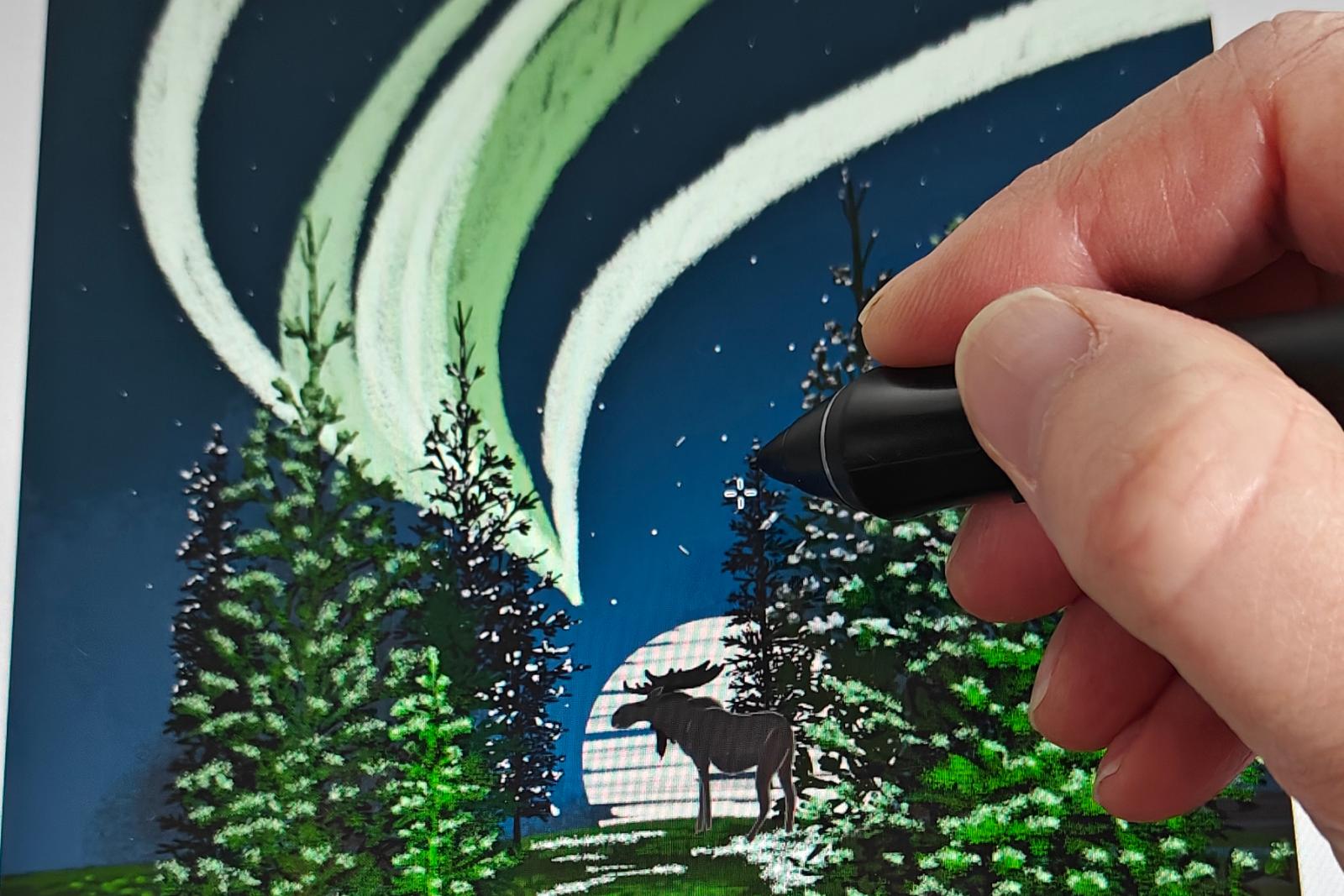
That’s why I keep drawing it: not a single perfect northern lights display, but its many faces, month after month.
First northern lights
Watching the northern lights
I didn’t see my first northern lights in Finland, but on the Norwegian coast, near Tromsø, on an April night! That’s where I got the taste for spending an entire winter season spotting the northern lights. Not just one winter, but many winters that followed.
Then came season after season in Lapland, on the Ounasjoki, where I watched as the same northern sky never behaved the same way twice.
The northern lights season lasts longer than most people expect. As soon as the nights in late summer become truly dark, the northern lights are already possible: the first sightings of the season were reported online as early as mid-August above Rovaniemi. From that moment on, the season continues until April, when the returning daylight eventually drives it away. During those months, the northern lights are never the same. They are faint and shy, then patient and slow, and then suddenly everywhere at once.
The quiet months, and the spectacular nights
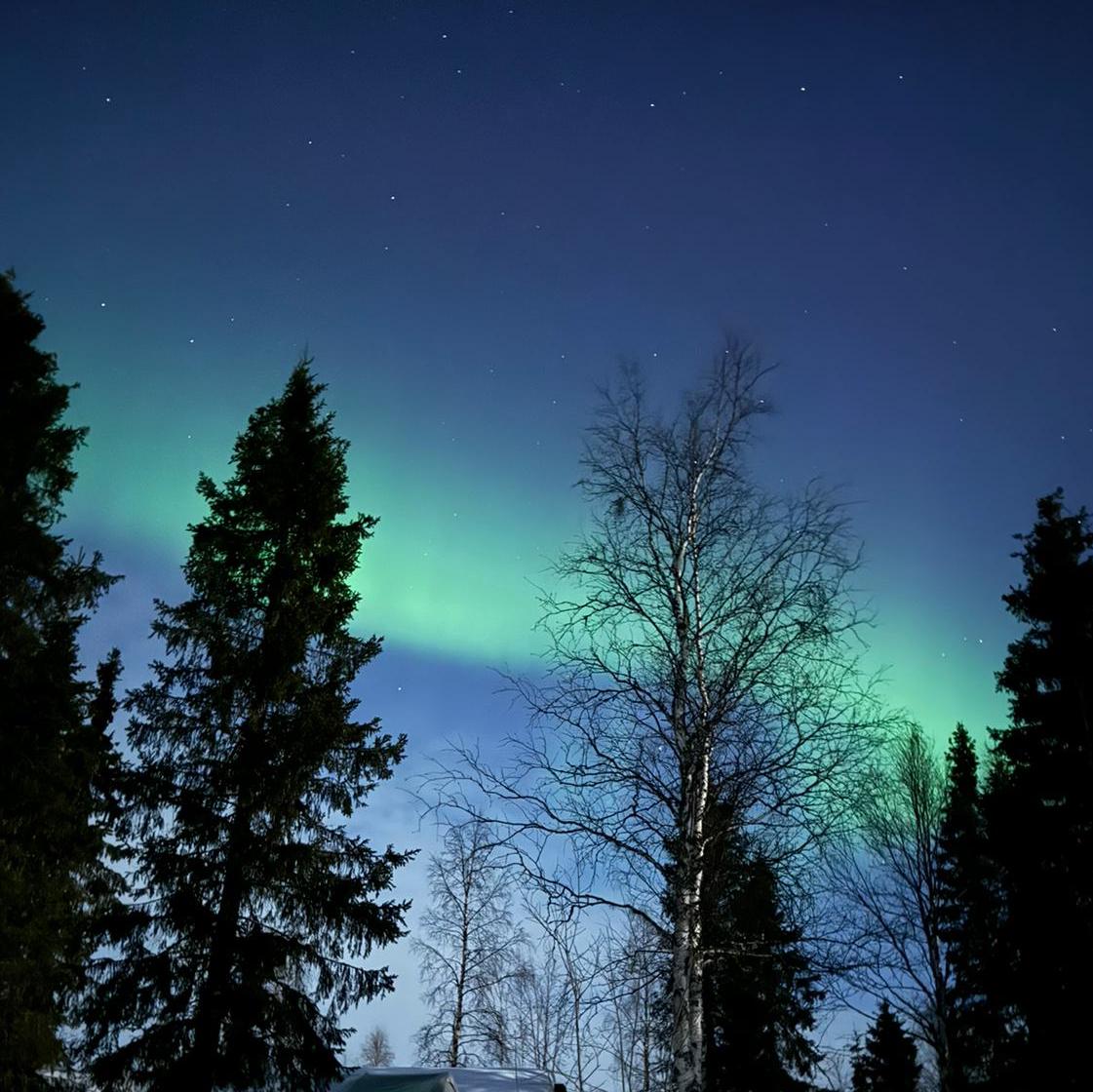
During the quieter periods of the season, a beautiful night can consist of a single long green streak, low above the birch trees, which lingers for a moment before fading away. You learn to love those nights too. They invite you to take it easy and simply look, rather than reaching for your camera straight away.
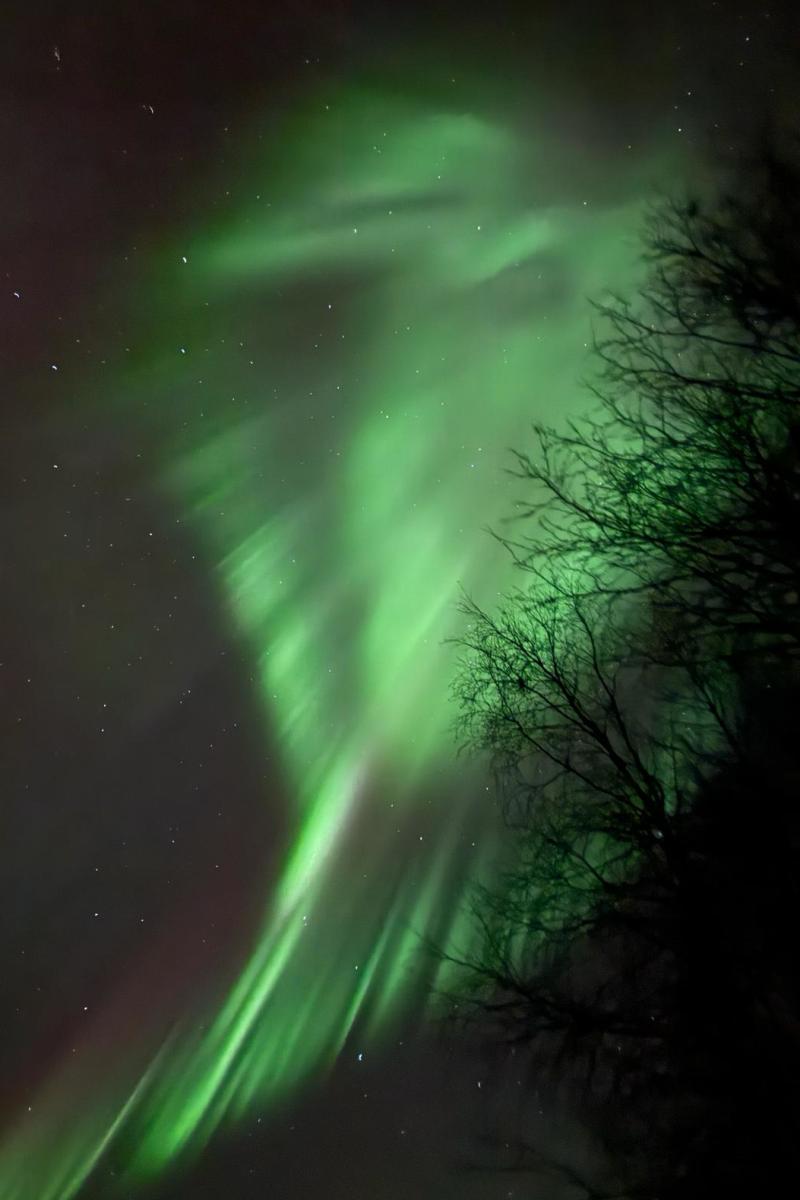
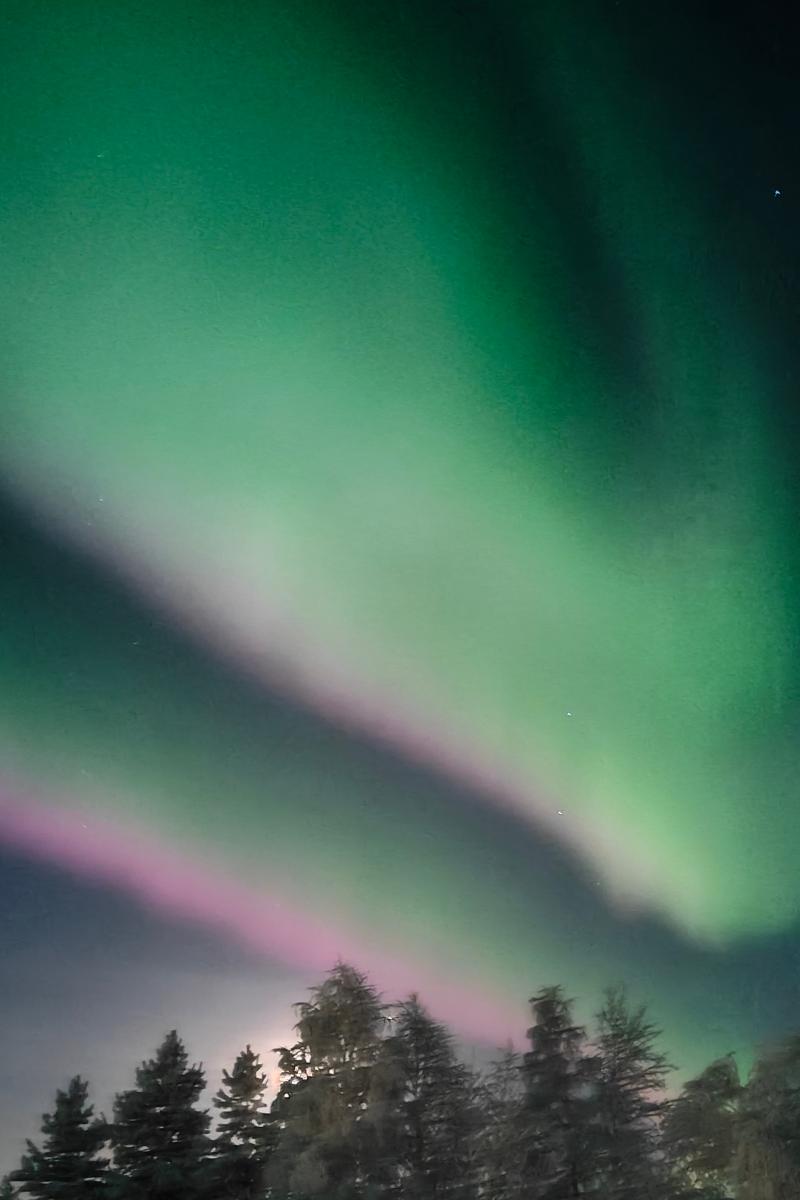
And then there are the spectacular northern lights displays. On the wilder nights, the green light rises high into the sky and begins to move, and if you’re lucky, a strip of pink or magenta appears along the lower edge.
And one evening in February, the whole sky suddenly closed in to form a corona directly above us. It descended so suddenly and danced in a ring around us that all we could do was lie back in the snow and look straight up at it. I will remember that moment for the rest of my life. It was one of those nights when counting the months seems pointless, and one of those nights that later found its way into an illustration such as Northern Lights Reflection.
Three Northern Lights I had to draw
Because no two nights are the same, neither are my illustrations. Each illustration shows a different facet of the northern lights: a different colour, a different shape, a different atmosphere. These three belong together here, because together they express exactly what I most want to say. The most beautiful month is: every month.
August Aurora
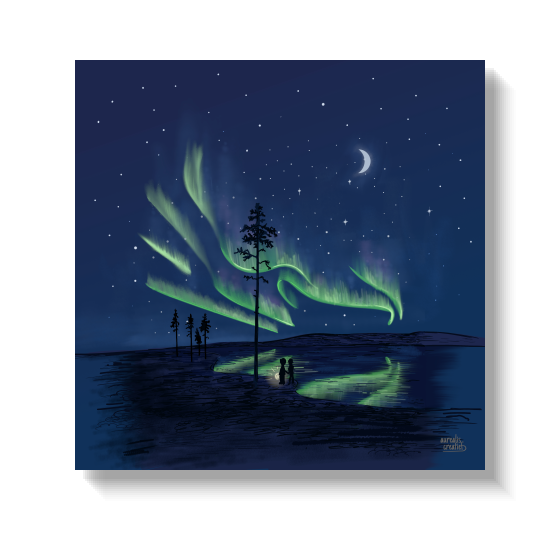
The August aurora marks the earliest start to the season. No snow yet, the ground still dark, the night finally dark enough for the northern lights to reappear. Every August, I find myself looking forward to the first reports from the far north, waiting for that first sighting just as other people wait for the first snow. This illustration captures that feeling: green above a solitary pine by the water, a little couple standing small beneath it, a thin crescent moon. On the very evening I am writing this, a geomagnetic storm is forecast for the north. It is already August, and it is beginning again.
Hidden Moose
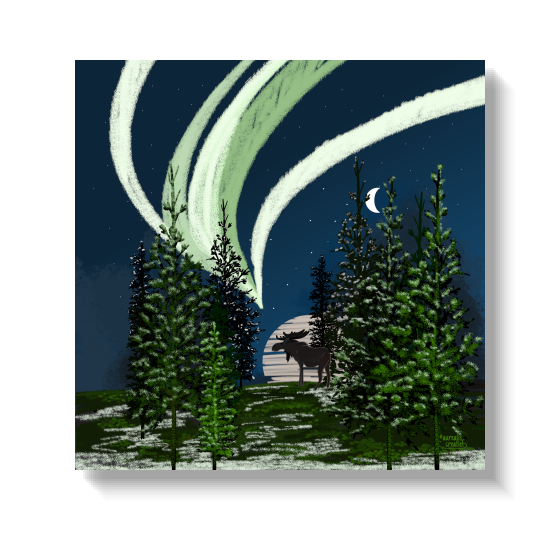
‘Hidden Moose’ is a figment of my imagination. I’ve seen a moose in daylight on more than one occasion, and I still quietly hope to spot one standing beneath the northern lights. This image is so different from the resting reindeer you see everywhere on Pinterest. Here he stands, half-hidden amongst the pines, alert, in what feels like his first winter, with soft veils of light hanging above him and the moon low on the horizon. The northern lights above him are of the dreamy, slow-moving kind you see in the quieter months, more drifting than dancing. It isn’t yet the height of winter, and that is precisely why it fits so well with the changing of the seasons.
Northern Lights Reflection
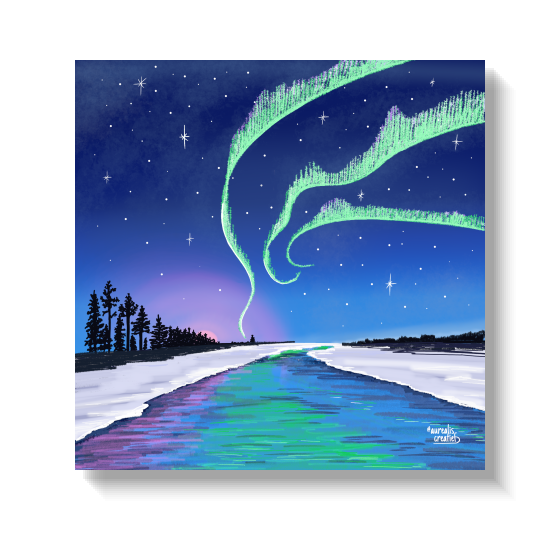
'Northern Lights Reflection' was directly inspired by the riverbank behind our cottage. We would often stand by the Ounasjoki at night, where the current is fast enough to keep the river free of ice, and watch the northern lights mirrored in the black water. It was bitterly cold, so cold that our toes went numb, and yet we stayed there. This illustration captures that memory: a bright green aurora reflected in a half-frozen river between snow-covered banks. Different every month, yet every month worth crawling into bed with cold feet.
If you’re setting off on your own to spot the Northern Lights
If you’re hoping to see the northern lights with your own eyes, the best advice I can give you is this: let go of the idea of the ‘perfect month’. Come whenever you can, on the darkest, clearest nights you can find, and set aside more than one evening for it.
The weeks around the equinox are a really good bet, but I’ve found that a supposedly quiet week has sometimes turned out to be the most beautiful of the whole winter. Dress much warmer than you think you’ll need to. That way, you can stay outside a bit longer if it does turn out to be a quiet night after all! Oh yes, the northern lights come in bursts; after a good burst, there’s a 20 to 40 minute lull and then they return! You’ll be rewarded if you’re patient.
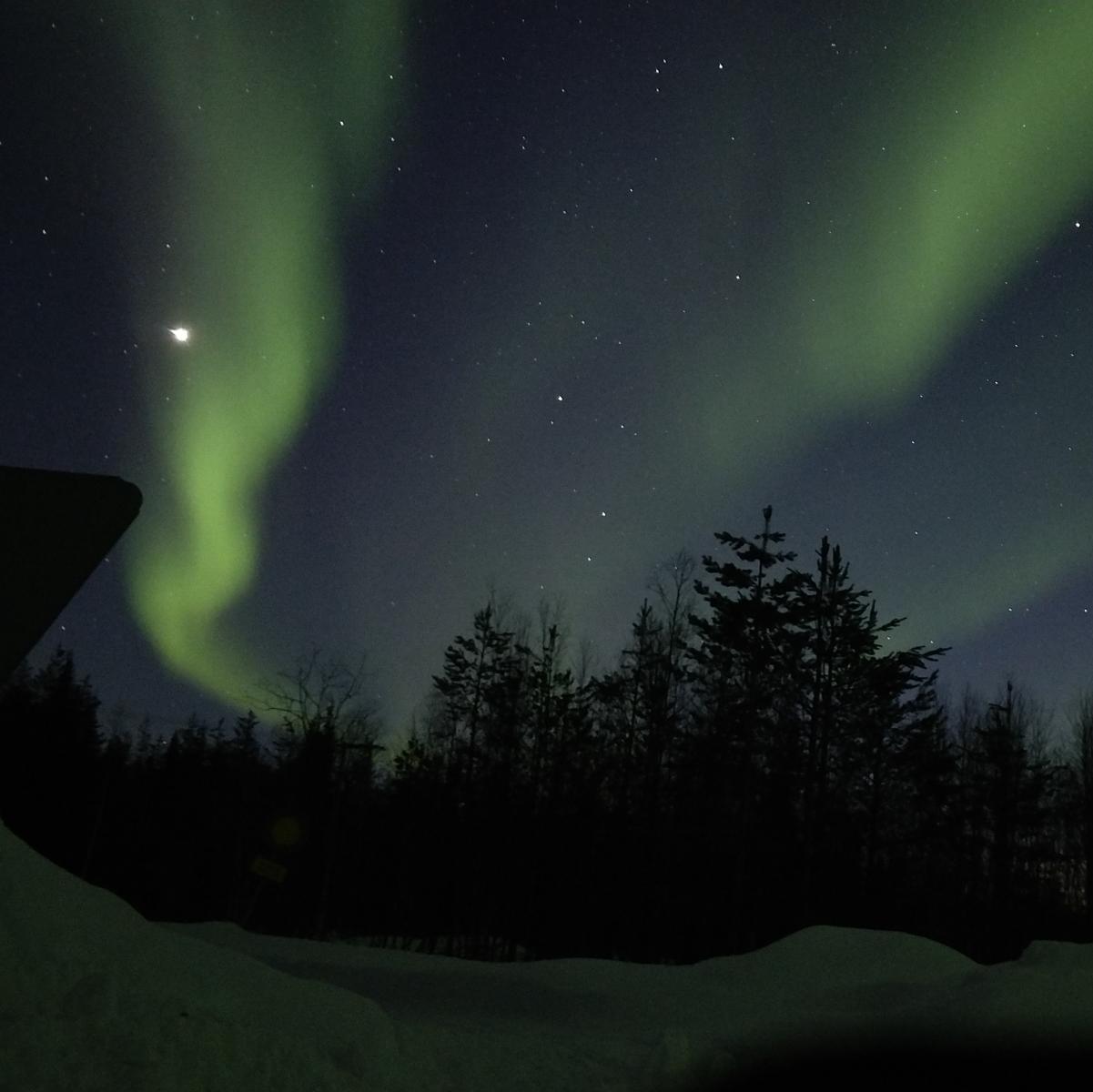
I’m not a photographer. Every photo on this page was taken with my mobile phone, blurry and imperfect. The memory always lingers longer than the photo, and it’s that memory I try to capture in the illustrations.
Every month, time and time again
So when someone asks me what the best month is, I’ve stopped circling a date. Winter after winter, towards the peak of the sun’s roughly eleven-year cycle, I watched it change: the first year still calm, and by the last winters even the quiet months put on a show. Even the hundredth time, yes, even the two hundred and fiftieth, it still left me in awe. That’s the honest answer. Every month is the best month to spot the northern lights and simply to look up and be amazed by this natural phenomenon!
If you want to know how the months really relate to one another, and what the equinox effect is, you’ll find that story in Arctic Adventures. And if you’re curious about how the way I draw the northern lights has changed over the years, that’s another story altogether, which will appear in this series soon.
Frequently Asked Question
Is there a best month to see the northern lights?
To be honest, the northern lights can appear on any dark, clear night throughout the season, roughly from late August to early April. Around the autumn and spring equinoxes, there is a well-known peak in activity, during which the northern lights are often visible for several nights in a row, and that is certainly worth chasing. But I’ve seen quiet months suddenly become spectacular without warning, and busy months fall silent. If you’d like a more complete picture of how the months compare and how the equinoxes affect things, I’ve written a separate article on the subject.
STORY BEHIND
Bring an aurora home
Each of these northern-lights illustrations is available as an art block, a metal print or an acrylic glass piece, drawn entirely by hand from nights like these.