
Three faces of Lady Aurora
Finnish Lapland | the northern lights, seen through the eyes of an artist
Arctic adventure 04
Finnish Lapland
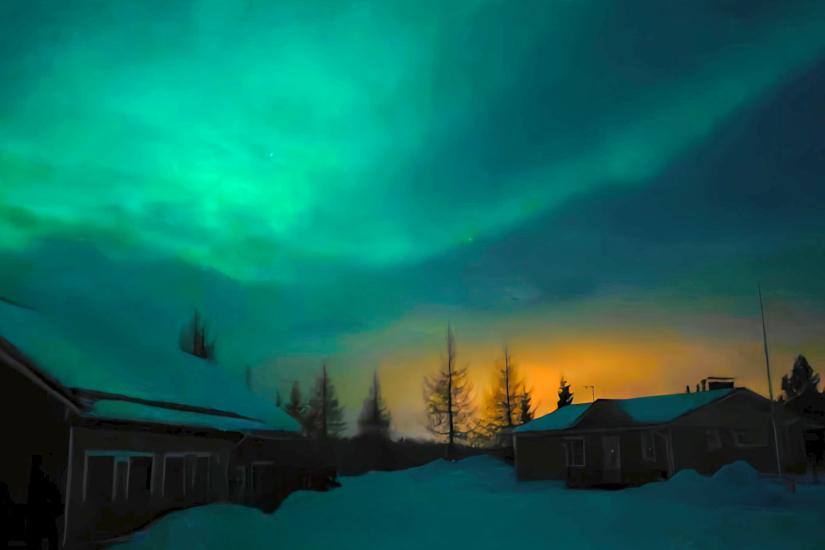
I did not go hunting for the northern lights the way a tourist does. I lived beneath them: for six years, over six winters in Finnish Lapland, the northern lights appeared above the woodshed, above the neighbours' house, above the riverbank at the end of the road. Some winters I saw them on 30 or 40 nights; other winters more than 50 times. You would think that seeing the northern lights so often would make them an everyday occurrence, but that was never the case. Even on the fiftieth night of a season, they still left me in awe.
These three illustrations were inspired by that sense of wonder. They do not simply depict an ‘ordinary night’ with the Northern Lights. They are, in fact, quite different from one another, as each one was created during a different season of Lapland’s eight seasons.
I have experienced the Northern Lights myself in winter and spring, but I have never personally witnessed the first Northern Lights of autumn; I know of them only from the initial reports that reached me from the far north. This collection is not a new series: it brings together three works from my ‘Lapland 8 Seasons’ collection, chosen because, when viewed side by side, they reveal just how many different faces the Northern Lights can take. It forms a bridge between ‘Arctic Adventures’ and the deeper seasonal narrative of the North, told in the only way I know how: through the eyes of someone who paints what she sees, and sometimes what she pursues.
Arctic Adventures · Northern Lights
Lady Aurora
All three featured works are available as premium illustrations on art blocks, metal plates, and acrylic glass prints.
You can also explore several aurora works in the Into the Nordic Wilderness-collection in the shop.
Three different nights
The same sky, three different nights
The northern lights are never the same twice. One night they hang motionless above the trees; the next they fill the sky from horizon to horizon with green waves and arcs. I have painted Lady Aurora three times, spread over three seasons, and each painting carries a different atmosphere, depicts a different landscape and reveals a different version of her.
Featured work
Green Reflection: aurora on open water
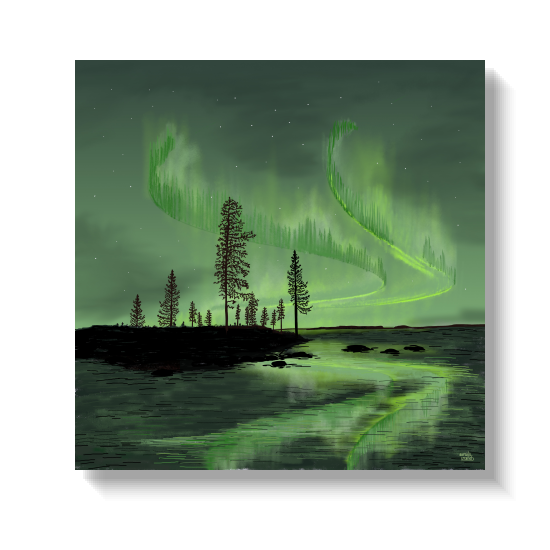
Above a dark island of pine trees, the northern lights rise in large, undulating shapes and are reflected in the still water below, doubling their green glow. This is the aurora at the very start of the season, before the first snow, when the land is still dark and the water has not yet frozen. It is the season of the double aurora: the reflection lasts only a few dark weeks before the rivers freeze over and are covered in snow.
This is the only aurora I have never witnessed myself. Those very first weeks fall within the time of year when I was not in Lapland, so this illustration is not based on a night I experienced. It grew from an image that moved me, a photograph of that impossible double green that I came across in my own feed. For me, this is the moment the countdown begins: every year I look forward to the first reports reaching me from the far north, and just as other people look forward to the first snow, I count down to my first aurora of the season. I say more about this longing in the Story Behind article Every month, a different aurora.
The aurora doubles herself in a river that has not yet frozen, in the earliest dark weeks of the season.
This work belongs to the First Snow season of Lapland 8 Seasons.
Sub-Zero Winter: aurora over a frozen river
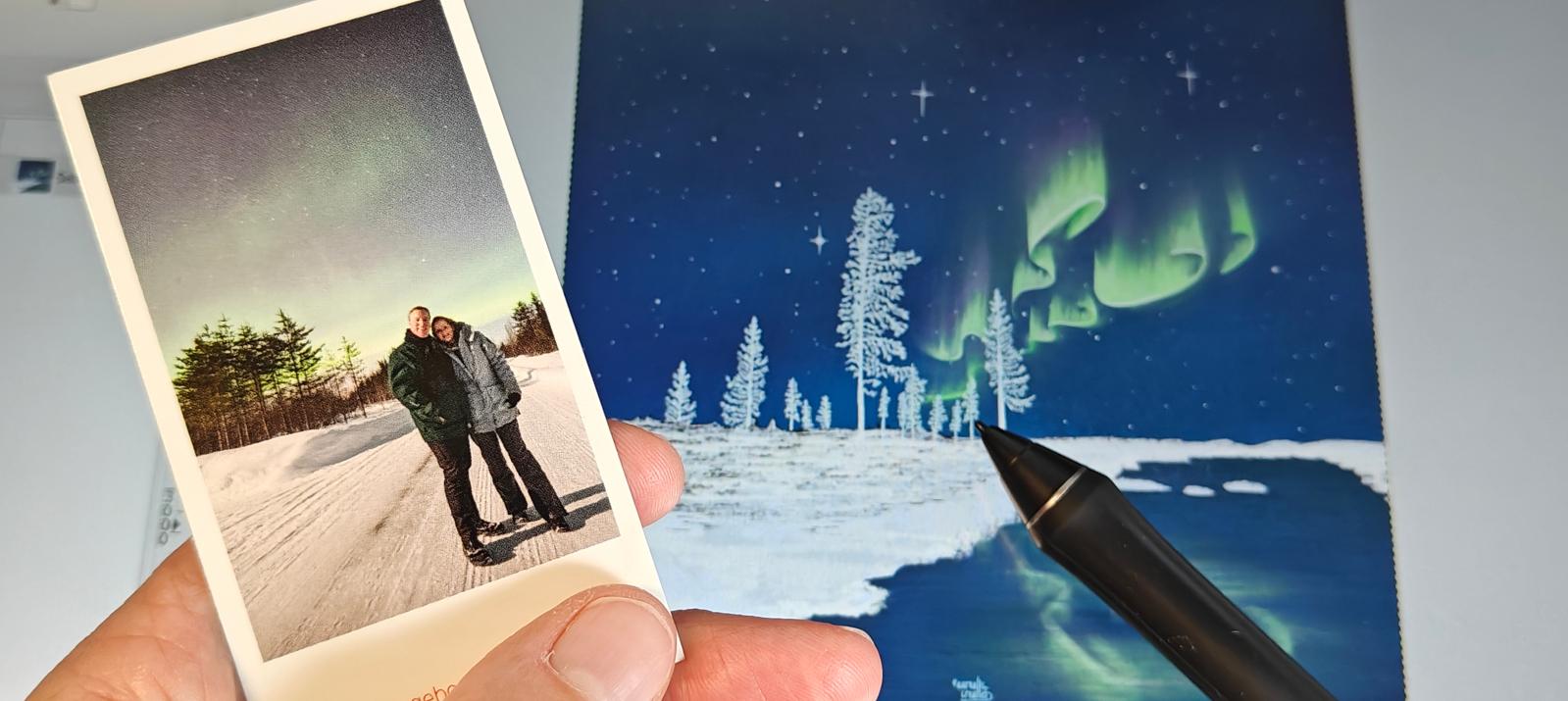
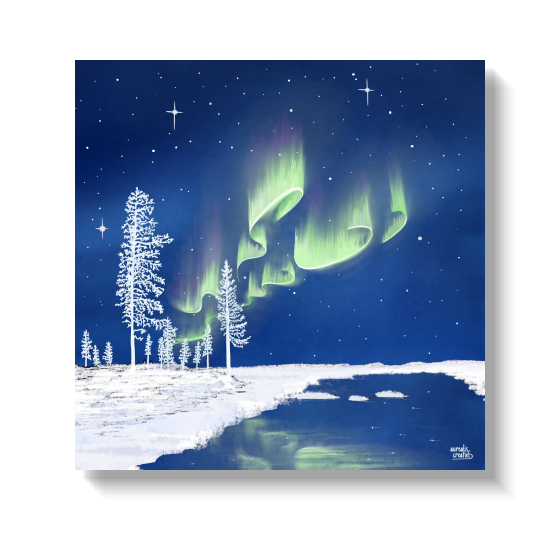
In the depths of winter, all that surrounding snow makes the world quiet, and yet the sky itself is full of life and movement. The northern lights dance above a frozen river, the green shapes rising and falling like flames, and at the upper edge of the aurora a rare, soft hint of pink-purple appears. This is the highlight of the season, in the darkest weeks of the year, and it is the sight I lived with most often: the aurora that lures you back outside after the sauna, into 15 or 20 degrees below zero, simply because it wants to be seen, night after night. This is the illustration on the drawing tablet in the photo at the top of this article, alongside a small print of the two of us, standing beneath exactly such a night, the kind you remember for the rest of your life.
This work belongs to the Deep Winter (kaamos) season of Lapland 8 Seasons. During the polar night the aurora can appear surprisingly early in the evening; I say a little more about that in the Deep Winter story.
Arctic Campfire under the Northern Lights: aurora beside the fire
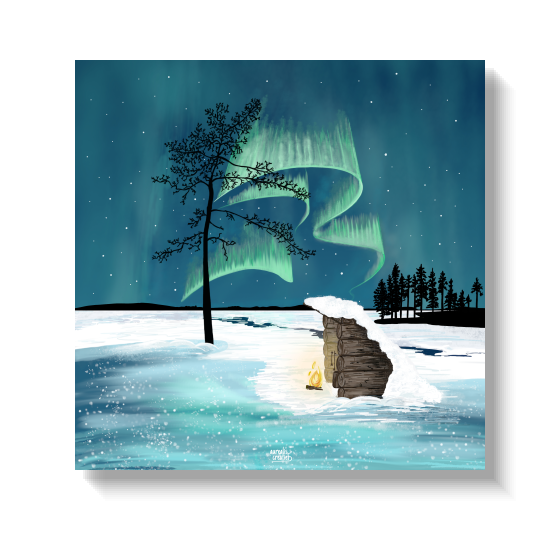
A small kota, its campfire radiating warmth into the cold night, sits beneath a beautiful arc of the northern lights. The aurora appears in soft green waves, calm and hanging in long strips like curtains high in the sky, while the landscape stays still, with a solitary pine and glistening ice crystals. The contrast with Green Reflection is striking, in both landscape and colour: a warm fire below, cold green light above. These are the northern lights in spring, when the nights are still dark enough for the aurora but the bitter cold has begun to ease. It is the silence the North promises as the season draws to a close, the opposite of a storm, and just as worth staying up for.
A quiet spring night: warm fire below, cold green light above.
This work belongs to the Crusty Snow (spring) season of Lapland 8 Seasons
Beautiful aurora
The night that the northern lights rolled over us
If you ask me why I drew so many auroras, I think back to a night during our very first winter. It was about 15 degrees below zero. All evening there had been faint veils, appearing and disappearing, and we were already on our way back to the cabin when the whole sky suddenly came to life. It did not so much appear as arrive: a vast, vivid burst that rolled in from the north and swept straight over our heads towards the south. No soft veils this time, but flames, arcs, circles and rings, green and red intermingled. I had never seen anything like it, and once the storm had passed it simply faded away, as if someone had switched off the light.
What I remember most is not the colour. That night we had family staying with us, and one of them is colour-blind and had never been able to see the aurora before. As it rolled over us, even he could see something moving in the sky: the sheer motion of it was visible even to someone who cannot see its colours. A photograph can never truly hold this kind of night, but my illustrations do reach for it, so that the magic of the northern lights might stay within reach of everyone.
A note, from someone who watched more than she photographed
I have never taken professional photographs of the northern lights. My old phone simply could not capture them, however carefully I set the shutter speed or steadied it on a tripod. Even with my most recent phone I did not want to spend the night fiddling with settings, and the hand-held frames came out blurry anyway.
I would rather watch the aurora with my own eyes than through a screen. Every photo I have is of poor quality, but the memory behind it is perfect, and that has always been enough for me.
So my one practical thought, if you come north to look for her yourself, is this: go out once with a professional aurora hunter. They know the dark, beautiful spots and the right moment, and on a cloudy night they will drive you a long way to reach a clear sky. And if your cabin happens to have a hot tub, a warm wooden tub full of hot water, you might have one of the most beautiful nights of your life without going anywhere at all. You sit in the warm water and watch the aurora dance above you. Warm below, cold and shining above: the very same contrast I painted into Arctic Campfire.
Frequently asked question
Where in Lapland do you have the best chance of seeing the northern lights?
The northern lights are not spread evenly across the North; it is not the case that you can see them throughout Scandinavia. They concentrate in a ring around the magnetic pole, known as the auroral oval, which on a clear night lies at roughly 65 to 72 degrees north. The closer you are to that band, the less solar activity is needed and the more often the aurora appears. Finnish Lapland sits squarely within it.
Rovaniemi, on the Arctic Circle at approximately 66 degrees north latitude, is already in a favourable location. The region where I lived, some 200 kilometres further north, lies even deeper within the oval, which is one of the reasons why this is the best place to spot the Northern Lights.
When solar activity is high, the oval widens and the Northern Lights extend much further south, even as far as central Europe (Belgium, the Netherlands, Scotland, etc.), but for a reliable chance of seeing them, it is particularly important that you are within that band of 65 to 72 degrees, under a dark and clear sky.
Arctic Adventures
Whale Safari
Arctic Adventures · Northern Lights
Follow Lady Aurora further
These are just three of Lady Aurora's faces. If you would like to know which month offers the best chance of catching her, or how one aurora can look so different from the next, I tell that story in Every month, a different aurora, part of the Story Behind series. And if you are curious how the way I draw the aurora itself has changed over the years, that story will be online soon.
You can also explore several aurora works in the Into the Nordic Wilderness collection in the shop.
Discover the collection in the shop